A Molecular Route from Nanographene to Nanodiamonds
Date:
Nanodiamonds are emerging materials for quantum sensing, bioimaging, single-photon emission, and quantum information technologies. However, the synthesis of ultrasmall nanodiamonds with precise control over size, crystallinity, and defect incorporation has remained a long-standing challenge.
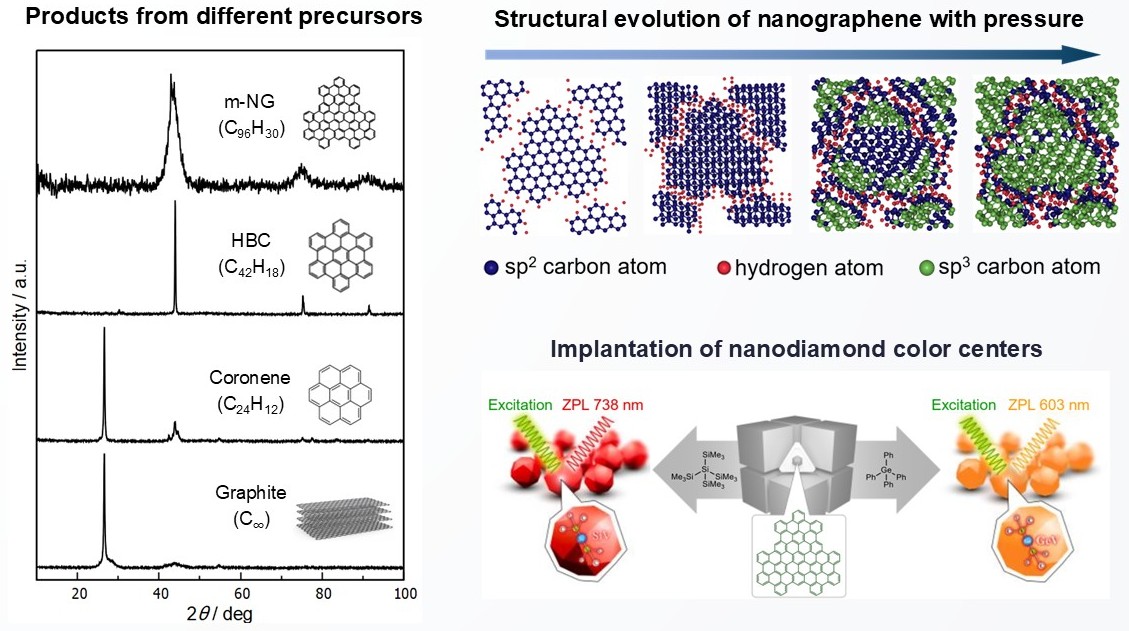
In our recent work entitled Bottom-Up Synthesis of Molecular Nanodiamond from Nanographene published in Nature, we demonstrate a bottom-up strategy for nanodiamond synthesis using an atomically defined nanographene. By subjecting hydrogen-terminated nanographene molecules to high-pressure and high-temperature conditions, we achieve monodisperse molecular nanodiamonds with diameters of only 3–4 nm. Importantly, the platform also enables the direct incorporation of quantum defects during synthesis. By introducing silicon- or germanium-containing molecular dopants, we achieved one-step synthesis of fluorescent nanodiamonds hosting SiV⁻ and GeV⁻ color centers, without ion implantation or post-synthetic annealing. These color centers are highly attractive for quantum sensing, photonics, and bioimaging applications.
This work establishes a general principle for the precise synthesis of nanodiamonds through molecular design. The ability to control crystal size, surface structure, and embedded quantum emitters directly from molecular building blocks opens exciting opportunities for next-generation quantum technologies, nanoscale sensing, and advanced carbon-based materials.
Reference: J. Liang et al., Nature 2026, 655, 102.
Related Reports:
Nanodiamonds made from tiny graphene triangles. (by Nature)
New route to tailor-made diamond nanoparticles holds promise for quantum applications. (by phys.org)