What happens when molecular springs are compressed?
Date:
Helicenes are fascinating helical molecules whose twisted structures resemble tiny springs. Although they have long been considered promising building blocks for molecular machines, little is known about how their properties change when they are mechanically compressed.
In a recent study published in Angewandte Chemie International Edition, we investigated the behavior of two π-extended helicenes, denoted as [7] and [9], under high pressure. Using a diamond anvil cell, we compressed these molecular springs while monitoring their fluorescence response in real time. Both molecules exhibited a pronounced redshift in fluorescence as pressure increased. Interestingly, the longer helicene [9] showed a significantly stronger response than [7], both in crystalline samples and in solution. These changes were fully reversible upon decompression, demonstrating the elastic nature of the molecular structures.
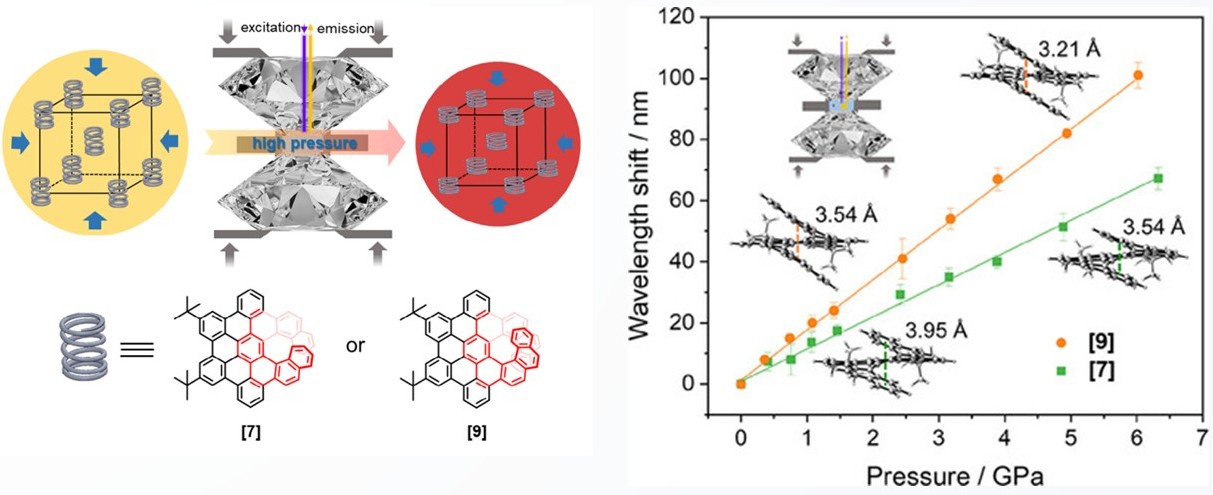
To understand the origin of this behavior, we combined high-pressure experiments with theoretical calculations. The results revealed that compression reduces the distance between overlapping aromatic rings within the helicene structure, enhancing intramolecular π–π interactions. Because [9] possesses a larger overlap region, its electronic structure is more sensitive to pressure, leading to larger fluorescence changes.
These findings provide direct experimental evidence that helicenes can function as molecular springs and highlight how their unique helical architectures influence optical properties under mechanical stress. The work opens new opportunities for designing pressure-responsive materials, molecular sensors, and future nanoscale machines.
Reference: J. Liang et al., Angew. Chem. Int. Ed. 2025, 64, e202500923.